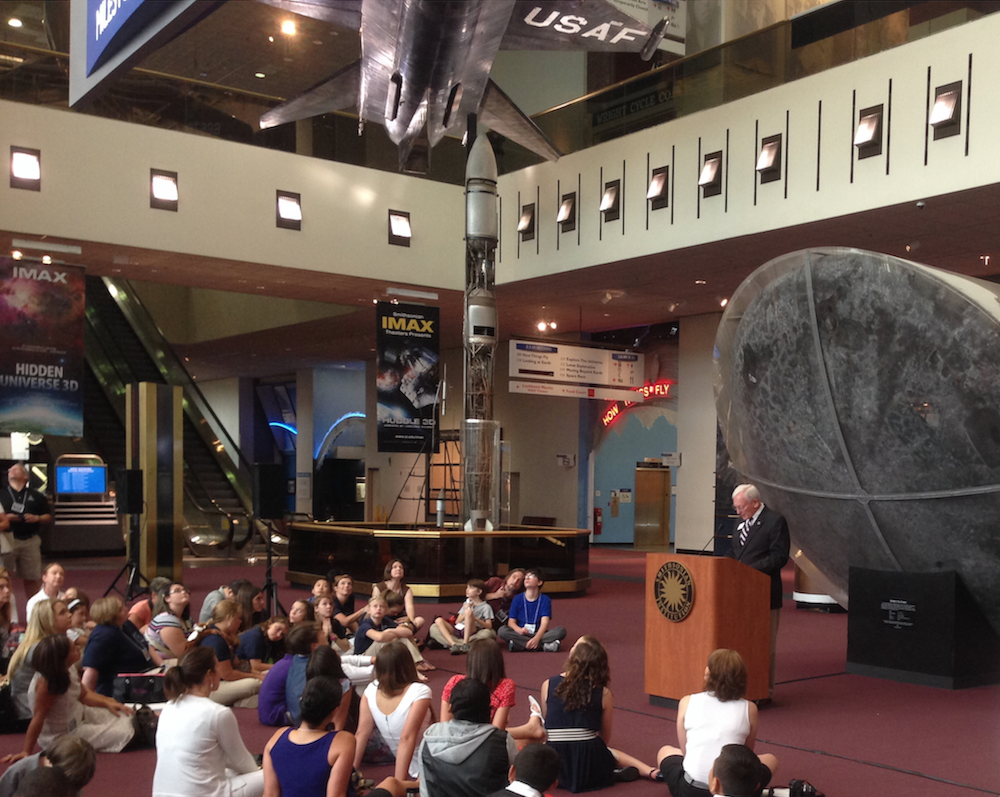
General John R. “Jack” Dailey, Director of the Smithsonian National Air and Space Museum, a SSEP National Partner organization, addresses 200 hundred delegates on Day 2 of the 2014 SSEP National Conference, July 3 ,2014. Behind him is Columbia, the Apollo 11 Command Module that safely returned Neil Armstrong, Edwin “Buzz” Aldrin, and Michael Collins from the Moon, and above him an X-15, the first winged aircraft to travel 4, 5 and 6 times the speed of sound. General Dailey has said that SSEP “may be the most important development for the future of the U.S. space program” (read about it). CLICK TO ZOOM
The National Center for Earth and Space Science Education and the Arthur C. Clarke Institute for Space Education are proud to be partnering with the organizations listed below on the Student Spaceflight Experiments Program.
Our SSEP National Partners are organizations that provide unique assets and capabilities that enhance the program on a national level. A multi-faceted partnership with the Smithsonian National Air and Space Museum, and in particular the Museum’s Education Department, enables the Museum to serve as the host site for the annual SSEP National Conference, the hub for SSEP video downlinks with astronauts aboard the International Space Station, and the venue for all Step 2 Review Boards for SSEP Missions to ISS. A formal agreement with the Center for the Advancement of Science in Space (CASIS) ensures that SSEP is used to showcase utilization of the U.S. National Laboratory on ISS for STEM education. CASIS and Subaru of America, Inc., provided unrestricted underwriting to close budget shortfalls for communities in the U.S. that would otherwise be unable to participate. Magellan Aerospace, our National Partner in Canada, provided unrestricted underwriting to close budget shortfalls for Canadian communities participating in SSEP.
Our Conference and Launch Event Sponsors are organizations that provided underwriting for SSEP events, including activities at the launch site for SSEP community delegations in attendance, the annual SSEP National Conference in Washington, DC, and events of opportunity such as an SSEP presence at a conference.
A Word About Our Other SSEP Partners:
The Student Spaceflight Experiments Program (SSEP) is overseen by the National Center for Earth and Space Science Education (NCESSE). in the U.S., and the Arthur C. Clarke Institute for Space Education internationally. SSEP is enabled through a strategic partnership with NanoRacks LLC, which is working with NASA under a Space Act Agreement as part of the utilization of the International Space Station as a National Laboratory. NCESSE, the Clarke Institute, and NanoRacks are therefore designated SSEP Strategic Partners. Visit the Strategic Partners page to read about their SSEP programmatic roles and responsibilities.
Partnership is truly a hallmark of SSEP. Over 1,600 other organizations support SSEP at the local level, including: school districts, private schools, NASA Space Grant lead institutions and other universities, corporate foundations, businesses, community foundations, and local research institutions. These organizations are designated the SSEP Local Partners. To explore the Local Partners, visit the Communities & Local Partners page at the SSEP Community Network Hubsite.
Quick Scroll to SSEP National Partners and Sponsors
A. Current National Partners
1. Smithsonian National Air and Space Museum
2. International Space Station National Laboratory – Managed by CASIS
3. The National Space Grant College and Fellowship Program
B. Past National Partners
1. Subaru of America, Inc.
2. Magellan Aerospace
C. Past Sponsors
1. Big Kid Science
2. NASA Nebraska Space Grant Consortium
3. Carnegie Institution of Washington / Carnegie Academy for Science Education
A. Current SSEP National Partners
1. Smithsonian National Air and Space Museum
The Smithsonian National Air and Space Museum, in Washington, DC – one of the most visited museums on planet Earth – is host to the annual SSEP National Conference. The conference provides student teams from across the SSEP community network the opportunity to present on their experiment designs, and those teams that flew experiments can report results. The objective is to immerse students in the experience of a real science conference – their conference. The conference is typically held the first week of July so that attendees can take part in the 4th of July celebration in the nation’s capital. The conference takes place in the Museum’s Moving Beyond Earth gallery, and Museum research and curatorial staff have provided featured conference addresses. For more information on the National Conference, including agendas and presentation descriptions, and video clip archives of the student team presentations, visit the Annual SSEP National Conference page.
The National Air and Space Museum is the host site for live video-conferences with astronauts aboard the International Space Station, with bridging to thousands of participants across the SSEP community network. Enabled by NASA’s Teaching from Space Office, the first such video-conference took place on November 15, 2012, as part of International Education Week, and was conducted in collaboration with the U.S. Department of Education. A total of 12,400 students, teachers, administrators, and guests across 24 SSEP communities were connected live to ISS and the Museum’s Moving Beyond Earth gallery via the Smithsonian’s Vidyo videoconferencing system. At the time of the event, 23 SSEP experiments were being conducted aboard ISS by Station Commander Sunita Williams. SSEP student microgravity researchers across the participating communities were able to ask questions of Commander Williams and Flight Engineer Kevin Ford. Watch the video-conference which was simulcast on NASA TV.
The National Air and Space Museum is also host site for meetings of the SSEP Step 2 Review Board, where finalist flight experiment proposals from each community are reviewed, and the flight experiments are selected. The Review Boards also include Museum staff. To date, the Museum has hosted Step 2 Review Boards for SSEP Missions 1 through 12 to ISS.
For additional information, visit: http://airandspace.si.edu
2. International Space Station National Laboratory – Managed by the Center for the Advancement of Science in Space (CASIS)
The Center for the Advancement of Science in Space (CASIS) is tasked with managing the International Space Station (ISS) National Laboratory (NL) in accordance with a Cooperative Agreement with NASA. In June 2012, the National Center for Earth and Space Science Education and CASIS entered into a Memorandum of Agreement to mutually leverage, through education and public outreach efforts such as SSEP, an understanding of ISS as a national and unparalleled platform for innovation, which can benefit all humankind and inspire a new generation to look to the stars.
As part of this Agreement, CASIS also provides underwriting to close budget shortfalls for communities that would otherwise not be able to participate in SSEP. To date, CASIS underwriting has dramatically impacted participation in SSEP Missions 3 through 13 to ISS, which has seen a combined 98,600 students engaged in microgravity experiment design, submission of 19,561 flight experiment proposals by student teams, and selection of 228 experiments performed by the astronauts aboard the International Space Station.
 Operated and managed by the ISSNL, through CASIS, the Space Station Explorers consortium is a network of organizations that use the power and appeal of the International Space Station to engage students, and provide creative ways to learn and explore STEM concepts and skills using ISS. The National Center for Earth and Space Science Education (NCESSE) is a member of the consortium.
Educators are welcome to join a network of volunteers – the Space Station Ambassadors – who share their excitement about the International Space Station with their students, peers, and communities. The Space Station Ambassadors program is open to all educators, leaders, and lifelong learners. Ambassadors connect with other enthusiasts and enjoy access to a great variety of educational resources.
Watch Ken Shields, CASIS Director of Operations, present at the 2013 SSEP National Conference.
For additional information, visit: http://www.iss-casis.org/ and explore all CASIS’s educational partners.
3. The National Space Grant College and Fellowship Program
In 1988, the United States Congress established the National Space Grant College and Fellowship Program (‘Space Grant’). Space Grant funding supports predominantly undergraduate and graduate education and research in space-related disciplines, but also supports pre-college and informal education initiatives.
Space Grant is a network of 52 consortia of predominantly colleges and universities – nearly 500 in number. There is a consortium serving each of the 50 States, the District of Columbia, and Puerto Rico. Each consortium is associated with a lead university, with consortium member institutions comprised of colleges and universities across the State. Educational non-profits, with a similar disciplinary focus, can also be consortium member institutions.
Space Grant is funded by Congress. NASA is the federal agency that has been administering Space Grant since 1989. The non-profit National Space Grant Foundation provides added support to the Space Grant institutions though activities in the private sector.
The National Center for Earth and Space Science Education (NCESSE) is a member institution of the Maryland Space Grant Consortium, overseen by Johns Hopkins University. Dr. Jeff Goldstein, NCESSE Center Director, and SSEP National Program Director, is also an Associate Director at Maryland Space Grant. Since SSEP program inception, NCESSE has partnered with 34 of the 52 Space Grant consortia through their lead institutions. NCESSE may be the only institution in the U.S. that has worked with so many Space Grant consortia.
As of March 25, 2025:
Through Mission 19 to ISS, a total of 34 Space Grant consortia have provided partial support for 152 of the 387 SSEP community programs conducted to date, enabling 60,730 grade 5-16 students to be engaged in microgravity experiment design. A total of 12,140 fight experiment proposals were submitted by student teams, resulting in selection of 152 flight experiments – one for each supported community. Through Mission 18, 152 of these experiments have been transported to – and operated in – low Earth orbit aboard the International Space Station.
Space Grant-supported flight experiments are associated with 19 of the 21 SSEP flight opportunities to date, including STS-134 and STS-135, the final flights of Space Shuttles Endeavour and Atlantis, and SSEP Missions 1 through 19, with the exceptions of Missions 15 and 19.
GO TO A LIST OF SPACE GRANT SUPPORTED SSEP COMMUNITIES AND MISSIONS
For additional information, visit: https://www.nasa.gov/offices/education/programs/national/spacegrant/home/index.html
B. Past SSEP National Partners
1. Subaru of America, Inc. – U.S. Partner (2011-2021)
As a company, Subaru of America encourages innovation and embraces a culture that includes empowerment and continual learning. We recognize the importance of education, and especially STEM education, in helping to prepare and inspire our youth to become the next generation of business, science, community, technology, and education leaders.
Subaru of America believes that engaging students in unique learning opportunities, such as this model initiative, are important in bringing STEM education to life. Subaru is proud to be a national partner of the Student Spaceflight Experiments Program.
As a National Partner, Subaru of America has to date made possible participation by 72 communities in 12 SSEP flight opportunities – SSEP Mission 2 to ISS, and Missions 4 through 14 to ISS. Due to Subaru’s commitment, these 72 communities engaged 24,933 students in microgravity experiment design, resulting in 5,710 flight experiment proposals submitted by student teams.
For additional information visit: http://www.subaru.com
2. Magellan Aerospace – Canadian Partner (2015 – 2019)
Magellan Aerospace believes strongly in the importance of youth and learning. We recognize the importance of education; especially STEM education, which is the groundwork for the next generation of scientists, and engineers.
Magellan Aerospace is proud to be a national partner, to help increase the opportunity for more Canadian students to participate in SSEP. Magellan sees this partnership as a investment in the youth of Canada, and in nurturing their interest in science and technology.
In the short period since SSEP expanded into Canada, the program has taken hold. Magellan participated as a local funding partner for the first two Canadian communities in Stonewall, Manitoba (SSEP Mission 3 to ISS) and Kamloops, British Columbia (SSEP Mission 6 to ISS) and experienced first-hand the once-in-a-lifetime learning opportunity that this program delivers to students. Now as a National Partner supporting communities starting with Mission 8 to ISS, Magellan Aerospace is very pleased to be able to contribute in a meaningful way, to bringing the SSEP experience to Canadian youth.
Magellan Aerospace is a global, integrated aerospace company that provides complex assemblies and systems solutions to aircraft and engine manufacturers, and defence and space agencies worldwide. From its corporate headquarters in Mississauga, Ontario, Magellan operates a network of facilities located in Canada, the United States, the United Kingdom, India and Poland.
As a Canadian National Partner on SSEP, Magellan Aerospace has to date made it possible for 10 communities across 4 Provinces to participate in 5 SSEP flight opportunities – SSEP Missions 8, 9, and 11 through 13 to ISS. Magellan also supported 2 communities in the U.S. where they have facilities, in Haverhill, MA, and West Babylon, NY. Magellan support also included a hands-across-the border SSEP partnership for Mission 13, between the Greater Fort Erie Schools in Ontario and the West New York STEM Hub in Buffalo-Niagara, NY. Due to Magellan Aerospace’s commitment, these 13 communities engaged 6,500 students in microgravity experiment design, resulting in 1,247 flight experiment proposals submitted by student teams, and selection of 14 experiments to be conducted on the International Space Station.
Click Here to See a Summary of Magellan Aerospace Impact per Mission
Summary of Magellan Aerospace Impact per Mission
Mission 8: Program Operations started February 23, 2015
Magellan Aerospace support allowed 2 Canadian communities to participate in Mission 8: Ryerson University and the Toronto School District Board, Toronto, Ontario; and University of Toronto Schools, Toronto, Ontario. These 2 communities immersed 375 students in microgravity experiment design, and resulted in 56 flight experiment proposals submitted by student teams.
Mission 9: Program Operations started September 7, 2015
Magellan Aerospace support allowed 2 Canadian communities to participate in Mission 9: Langevin School, North Calgary, Alberta; and West Vancouver School District, Vancouver, British Columbia. These 2 communities immersed 851 students in microgravity experiment design, and resulted in 227 flight experiment proposals submitted by student teams.
Mission 11: Program Operations started September 6, 2016
Magellan Aerospace support allowed 2 Canadian communities to participate in Mission 11: Coquitlam School District (43), Coquitlam, British Columbia; and Ecole Stonewall Centennial School, Interlake School Division, Stonewall, Manitoba. These 2 communities immersed 1,554 students in microgravity experiment design, and resulted in 334 flight experiment proposals submitted by student teams.
Mission 12: Program Operations started September 5, 2017
Magellan Aerospace support allowed 2 Canadian communities to participate in Mission 12: School District #68 Nanaimo, British Columbia; and Winnipeg School Division, Manitoba. These 2 communities immersed 835 students in microgravity experiment design, and resulted in 135 flight experiment proposals submitted by student teams.
Mission 13: Program Operations started September 4, 2018
Magellan Aerospace support allowed 2 Canadian communities to participate in Mission 13: Edmonton Public School Board, Edmonton, AB; and School District 69, Qualicum, BC. In addition, Magellan supported 2 communities in the U.S. in proximity to their facilities in Haverhill, MA, and West Babylon, NY: Montachusett Regional Vocational Technical School, Fitchburg, Massachusetts; and South Huntington School District, Suffolk County, New York. Magellan also supported a hands-across-the border SSEP partnership between the Greater Fort Erie Schools in Ontario and the West New York STEM Hub in Buffalo-Niagara, NY. These 5 communities immersed 2,900 students in microgravity experiment design, and resulted in 505 flight experiment proposals submitted by student teams.
For additional information visit: http://www.magellan.aero
C. Past Conference, Review Board, and Launch Event Sponsors
Big Kid Science provides fun and scientifically accurate books on topics in the Earth and space sciences for young adults, written by astrophysicist, educator, and company founder Dr. Jeff Bennett. Big Kid Science sponsored the launch event for SSEP Mission 3b and Mission 4 community delegations attending the launch of Orb-1 at the Mid-Atlantic Regional Spaceport (MARS), Wallops Island, VA, on January 9, 2014. Aboard the Cygnus spacecraft were the Mission 3b Falcon II payload of experiments, and the Mission 4 Orion payload of experiments. For additional information visit: http://www.bigkidscience.com
2. NASA Nebraska Space Grant Consortium
The NASA Nebraska Space Grant Consortium sponsored the SSEP Community Network Meetings held at the Florida Institute of Technology in concert with the launches of STS-134, in May 2011, and STS-135, in July 2011. Nearly 300 SSEP students, teachers, parents, and stakeholders attended each of these launches. Consortium Associate Director Michaela Lucas delivered featured presentations on the National Space Grant Network at the meetings. For additional information visit: http://ne.spacegrant.org
3. Carnegie Institution of Washington / Carnegie Academy for Science Education
The Carnegie Institution of Washington (CIW) was the host site for meetings of the SSEP Step 2 Review Boards in November 2010 for SSEP on STS-134 aand May 2011 SSEP on STS-135. These Boards selected the SSEP experiments to be flown on the final two Space Shuttle flights. We are proud that CIW staff have participated in nearly every SSEP Step 2 Review Board since program inception in 2010.