4:34 pm Eastern, 5/12/26: NASA has just scrubbed the launch, next attempt 5/13/26, 6:50 pm Eastern
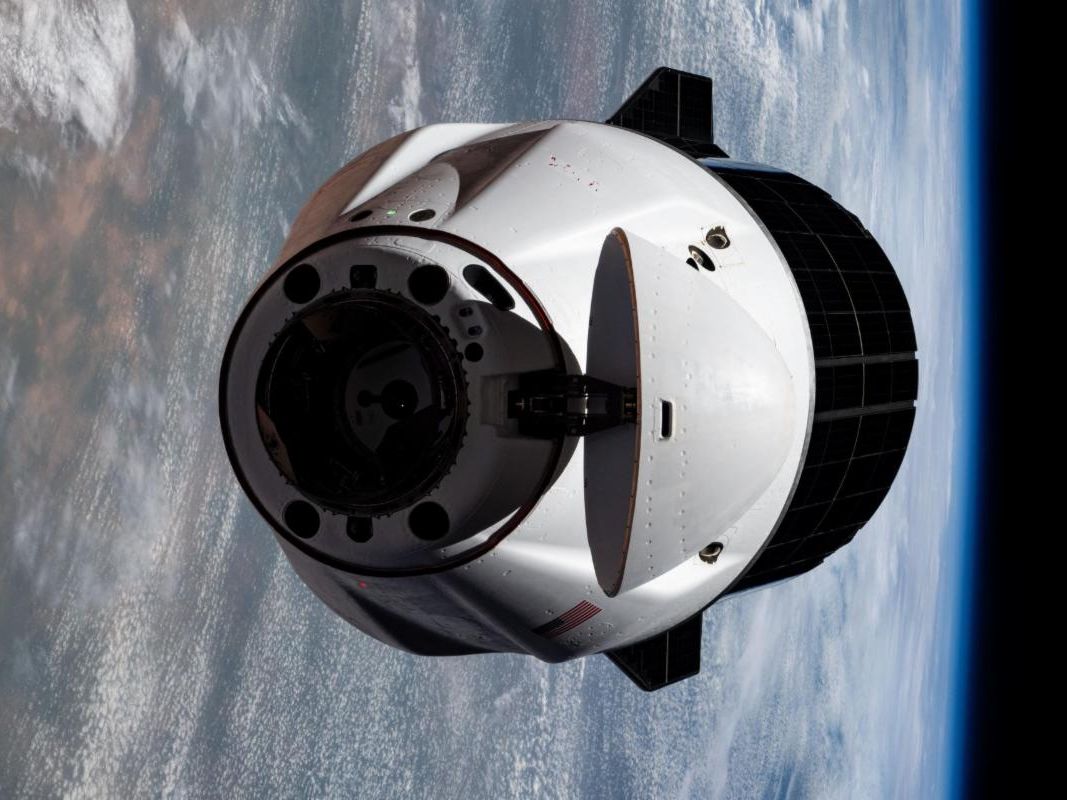
A SpaceX Dragon cargo spacecraft supporting NASA’s SpaceX CRS-33 mission approaches the International Space Station on Aug. 25, 2025, for an automated docking to the Harmony module’s forward port. Credit: NASA
Launch of SSEP Mission 19 to the International Space Station
From Dr. Jeff Goldstein
Student Spaceflight Experiments Program (SSEP) National Program Director
Center Director, National Center for Earth and Space Science Education
The SSEP Mission 19 to ISS flight experiments payload, designated Endeavour and containing 20 flight experiments, is scheduled to launch Tuesday, May 12, 2026, at 7:16 pm ET from Space Launch Complex 40 (SLC-40) at Cape Canaveral Space Force Station, Florida, aboard SpaceX CRS-34 (SpaceX Commercial Resupply Services 34).
A heartfelt congratulations to the 7,288 students that participated in Mission 19 microgravity experiment design, and submitted 1,178 flight experiment proposals for formal review and selection; the 18,567 students that participated in the Mission Patch art and design competitions; and the 86 student Principal Investigators, Co-Investigators, and Collaborators comprising the student researcher teams for the 21 selected SSEP Mission 19 flight experiments (note: 1 Mission 19 experiment from Ukraine will fly later this year).
We are all exceedingly proud of you. You are the next generation of researchers, and today you stand on the frontiers of exploration.
Prior to launch, I would like to address SSEP Mission 19 students, and their instructors, administrators, and families. I want to provide a sense of their remarkable accomplishment – and not just the flight teams but the combined 25,000+ students engaged in microgravity experiment design and mission patch design competitions – and let them know they are truly part of America’s Space Program. I want to speak not just from the vantage point of the creator and director of SSEP, but also from the vantage point of 11 year old me watching the launch of Apollo 11 in July of 1969 and knowing in that moment I wanted to be a space explorer. There are these moments in our lives that change us, if we allow ourselves to be open to the experience, and maybe the launch of SpaceX-34, with your community’s experiment and mission patches aboard, can be one of those moments for many Mission 19 students. That’s why we created this program.
The launch will be covered live on NASA TV, and we’ve provided a video portal below if you’d like to watch right here on the SSEP National Program website. Also below is the May 6, 2026, NASA Media Advisory that provides NASA TV live coverage times for launch on Tuesday, May 12 and arrival at Station on Thursday, May 14.
I would also invite you to explore the SSEP Launch and On-Orbit Operations History page, which provides a sense of the rich history of the SSEP Program. Here you will find s list of SSEP missions and payload designations, videos of all SSEP launches, a list of all astronauts that have operated SSEP experiments, and videos of astronauts operating the experiments.
-Jeff
Schedule of Events
Tuesday, May 12, 2026
7:00 pm EST – NASA coverage of the launch of SpaceX-34 begins (on NASA+, Amazon Prime and YouTube)
Thursday, May 14, 2026
8:20 am ET – NASA coverage begins for Dragon docking at ISS (on NASA+, Amazon Prime and YouTube)
9:50 am ET – Docking
Mission 19 to ISS Historical Data
Number of Participating Communities: 20
Scope: 7,288 grade 5-16 students engaged in microgravity experiment design
Number of student team proposals received: 1,178
Number of experiments selected for flight: 21; 19 communities flying 1 experiment and 1 community flying 2 experiments – Ukraine (note 1 flight experiment from Ukraine will fly later this year).
Announcement of Opportunity: February 28, 2024
Experiment design competition and proposal writing: September 3 – November 5, 2024 (9 Weeks)
Flight experiment selection: December 20, 2024
SSEP Mission 19 Details
– webpages
Mission 19 Media Coverage: 14 articles as of 8/8/25
Mission 19 Community Profiles: 20 communities, 35 organizational partners, 347 schools
– Media Package downloadable documents (PDFs)
SSEP National Program Overview
Mission 19 Flight Experiments Summary Table
Mission 19 Flight Experiments: Research Teams and Experiment Descriptions – an experiment-by-experiment summary including community, school, grade level, research team (PIs, Co-Is and Collaborators), and experiment abstract
WATCH SPACEX LAUNCH LIVE ON THIS NASA TV PORTAL
MEDIA ADVISORY M26-037
NASA and SpaceX are targeting 7:16 p.m. EDT Tuesday, May 12, for the next launch to deliver science, supplies, and equipment to the International Space Station. This will be the 34th SpaceX commercial resupply services mission to the orbital outpost for NASA.
Carrying about 6,500 pounds of cargo, a SpaceX Dragon spacecraft will lift off aboard a Falcon 9 rocket from Space Launch Complex 40 at Cape Canaveral Space Force Station in Florida. Dragon is scheduled to dock autonomously at about 9:50 a.m. Thursday, May 14, to the forward port of the station’s Harmony module.
Watch NASA’s launch and arrival coverage on NASA+, Amazon Prime, and the agency’s YouTube channel. Learn how to watch NASA content through a variety of online platforms, including social media.
In addition to cargo for the crew aboard the space station, Dragon will deliver several new experiments, including a project to determine how well Earth-based simulators mimic microgravity conditions, a bone scaffold made from wood that could produce new treatments for fragile bone conditions like osteoporosis, and equipment to evaluate how red blood cells and the spleen change in space to protect future astronauts. The Dragon spacecraft also will carry a new instrument to study charged particles around the Earth that can impact power grids and satellites, an investigation that could provide a fundamental understanding of how planets form, and an instrument designed to take highly accurate measurements of sunlight reflected by Earth and the Moon.
The Dragon spacecraft is scheduled to remain at the space station until mid-June when it will depart the orbiting laboratory and return to Earth with time-sensitive research and cargo, ahead of splashing down off the coast of California.
NASA’s mission coverage is as follows (all times Eastern and subject to change based on real-time operations):
Monday, May 11
11 a.m.: Prelaunch media teleconference with the following participants:
Bill Spetch, operations and integration manager, NASA’s International Space Station Program
Dr. Liz Warren, deputy chief scientist, NASA’s International Space Station Program
Lee Echerd, senior mission manger, Government and Commercial Mission Management, SpaceX
Brian Cizek, launch weather officer, Cape Canaveral Space Force Station’s 45th Weather Squadron
Media who wish to participate by phone must request dial-in information by 10 a.m. on May 11, by emailing the NASA Kennedy newsroom at: ksc-newsroom@mail.nasa.gov.
Audio of the media teleconference will stream live on the agency’s YouTube channel.
Tuesday, May 12
7 p.m.: Launch coverage begins on NASA+, Amazon Prime, and YouTube.
Launch coverage also will be available on the NASA website, and will include live streaming and blog updates beginning no earlier than 7 p.m., and proceed as countdown milestones occur.
On-demand streaming video on NASA+ and photos of the launch will be available shortly after liftoff. For questions about countdown coverage, contact the NASA Kennedy newsroom at 321-867-2468. Follow countdown coverage on NASA’s International Space Station blog for updates.
7:16 p.m.: Launch
Thursday, May 14
8:20 a.m.: Arrival coverage begins on NASA+, Amazon Prime, and YouTube.
9:50 a.m.: Docking
Attend launch virtually
Members of the public can register to attend this launch virtually. NASA’s virtual guest program for this mission also includes curated launch resources, notifications about related opportunities or changes, and a stamp for the NASA virtual guest passport following launch.
Watch, Engage on social media
Let people know you’re watching the mission on X, Facebook, and Instagram by following and tagging these accounts:
X: @NASA, @NASASpaceOps, @NASAKennedy, @Space_Station, @ISS_CASIS
Facebook: NASA, NASAKennedy, ISS, ISS National Lab
Instagram: @NASA, @NASAKennedy, @ISS, @ISSNationalLab
Learn more about International Space Station operations and research at:
https://www.nasa.gov/station
-end-
SSEP is a program of the National Center for Earth and Space Science Education (NCESSE) in the U.S. and the Arthur C. Clarke Institute for Space Education internationally. It is enabled through a strategic collaboration with Rhodium Scientific, America’s first commercial space biotech company, working with NASA through a CASIS Agreement to utilize its facilities aboard the International Space Station. The International Space Station (ISS) National Laboratory is a National Partner on the Student Spaceflight Experiments Program.
Comments are closed.