
IMPORTANT NOTES
All information added or updated since this page first went up on October 9, 2026 is in GREEN TEXT below.
Information still to be determined (if any) is in RED TEXT below.
Dates and times that are subject to change at NASA’s discretion are in PURPLE TEXT below.
Last update of this page: October 9, 2026 at 11:31 AM ET
Quick Jump:
1. Introduction to the Log
2. Pre-Launch Activities
3. Launch and Docking
4. Flight Experiment Log, On-Orbit Operations: Mission 20 Atlantis Payload
5. Undocking and Landing
6. Return of Experiments to Student Teams
This page provides student flight experiment teams a log of all activities associated with the flight experiments comprising the SSEP Mission 21 Discovery payload from the time the flight RhFET-01s are received in Houston before the flight of SpaceX CRS-35 to the point when the mini-labs are shipped back to the flight teams after return to Earth. While this page will feature general progress reports on the status of the payloads, its main purpose is to provide updates to the student flight experiment teams as quickly as possible regarding the handling of their mini-labs on the International Space Station (ISS), so that they can effectively conduct their ground truth experiments. Teams are advised to bookmark this page and check it regularly for updates.
As per the SSEP Mission 21 to ISS: Flight Operations page:
Updates to Student Teams on the Progress of Their Experiment
The ISS crew will interact with the SSEP payload at times of the day that fit best in their overall work schedule. Even though crew interactions with the experiments are to take place on pre-specified Crew Interaction Days, the time of the interaction will vary from one Crew Interaction day to the next. After the crew has completed handling of the SSEP payload on a given Crew Interaction Day a report is generated by Rhodium Scientific who will forward the report to the SSEP flight operations team at NCESSE. We will then post the details of the report – including the time at which the payload was handled – on this page to make the information available to all student teams as quickly as possible. The report will be posted as soon as it is received, but it may take up to 24 hours for the information from the ISS to make its way to the Log. That means, for example, that the details of an activity conducted by the astronauts on the afternoon of a specified Crew Interaction Day will be posted on the Experiment Log no later than the afternoon of the following day (and likely far sooner than that).
Conducting Your Ground Truth Experiments
Ground truth experiments – the control versions of the experiment conducted on Earth while the microgravity experiment is being conducted in orbit – are an essential part of analyzing the results of the flight experiment. Once the flight experiment returns to Earth, simultaneous harvesting and analysis of both the flight experiment and the ground truth experiment allows the research team to assess the role of gravity in the physical, chemical, or biological system under study. It is hard to imagine how the role of gravity can be determined without ground truth experiments conducted at the same time as the flight experiment.
However, given that it may take up to a day to receive a report on exactly what time a specific activity was conducted with an experiment aboard the ISS, student teams are encouraged to shift activities with their ground truth experiments by 1 day (24 hours). That will allow teams to ensure that the timing of activities they carry out on their ground truth experiments accurately reflects the timing of activities with their experiment aboard the station. This is especially important for experiments that are sensitive to exact timing. For example, if a microbiological experiment is likely to produce different results depending on whether it is active for 40 or 50 hours, the teams will want to match the exact timing of the experiment aboard the station with their ground truth experiment.
SSEP Mission 21 to ISS Discovery Payload
Ferry Vehicle: SpaceX CRS-35 (SpaceX Falcon rocket with Cargo Dragon 2 spacecraft)
Launch Site: LC-40 Kennedy Space Center, Florida
Launch Date: October 13, 2026 at 6:33 AM ET
Launch Date History:
Originally Projected Launch Date: August 2026
Rescheduled to: NET October 2026
Rescheduled to: October 13, 2026
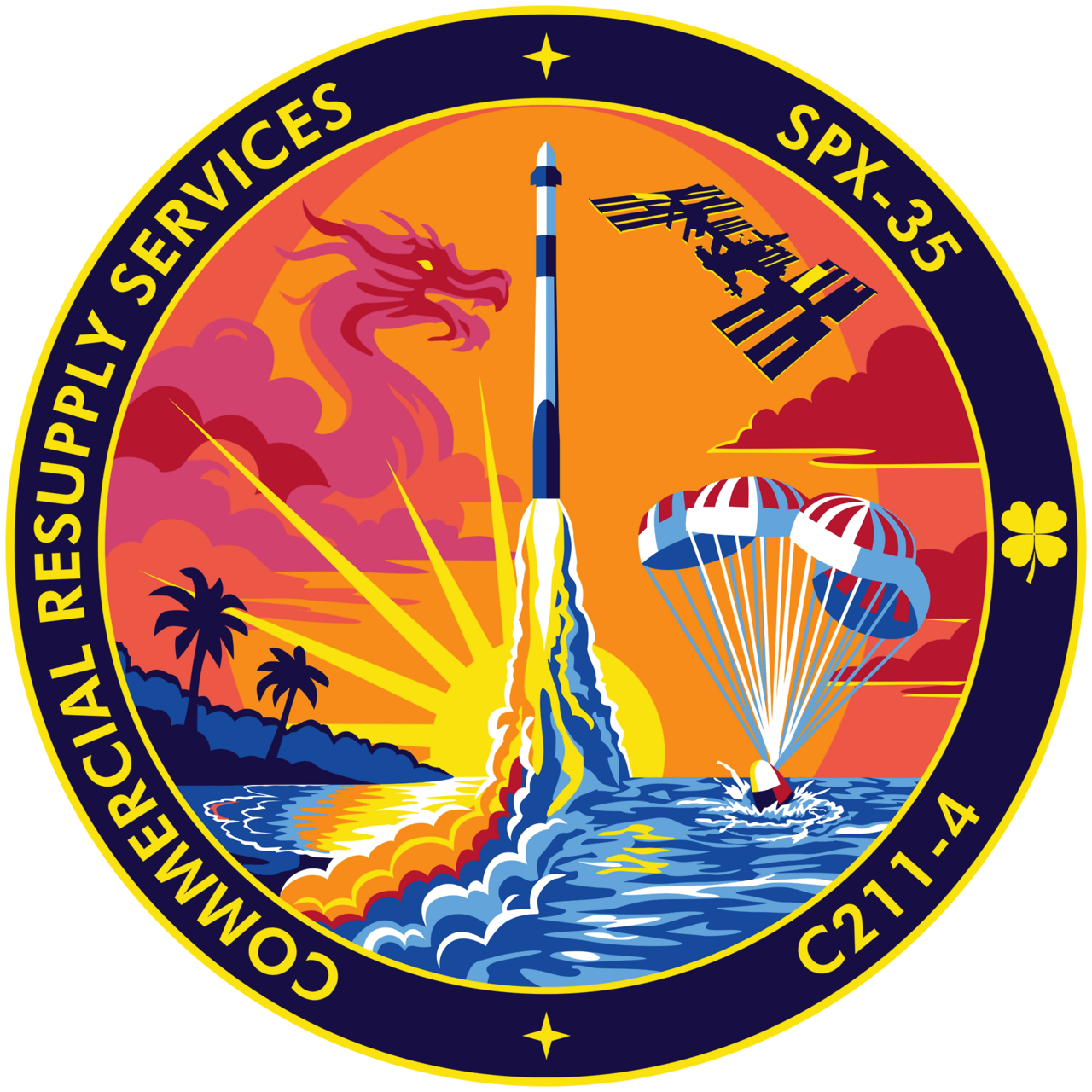
Official Mission Patch for SpaceX CRS-35
Rhodium Scientific Official Mission Patch for SSEP Mission 21 to the ISS

4. Flight Experiment Log, On-Orbit Operations: Mission 21 Discovery Payload
Interactions Scheduled Prior to Flight (subject to change) CLICK ON TABLE TO ZOOM

Record of Reported On-Orbit Interactions
Edmonton, AL, CAN: How Does Microgravity Affect the Oxidation of Copper in a Vinegar, Salt and Water Solution?
Mississippi Mills, ON, CAN: Would broccoli sprout faster in low gravity?
Phoenix, AZ: The Effect of Microgravity on the Growth and Structure of Covalent Organic Frameworks (COFs)
Pasadena, CA: The Effect of Microgravity on the Crystallogenesis of Hen Egg White Lysozyme
Colorado Springs, CO: Space Climate Seeds: Investigating Osmotic Stress-Primed Germination in Microgravity
Melbourne, FL: Effects of Microgravity on Neurodegeneration using Tauopathy Model
St. Petersburg, FL: The Effect of Microgravity on the Formation and Properties of Calcium Alginate Hydrogels
Tampa, FL: Microgravity Effects on Chitosan Hydrogel Structure for Potential Wound-Care Applications
New Orleans, LA: Coacervate Protocells in Microgravity: Stability, Function, and Implications for the Origins of Life Beyond Earth
Lowell, MA: Aging and Coarsening of Milk-Protein Micelles
Omaha, NE: Radiation Detection via Dosimeter Near Solar Maximum
Albany, NY: The effects of microgravity on red maple tree seed germination
Asheville, NC: How are lubricating oils affected by space travel?
Athens, OH: Examining the Effect of Microgravity on the Metabolism of the Antihistamine Promethazine HCl, using Caenorhabditis elegans as a Model
Pittsburgh, PA: Evaluating the Effect of Microgravity on Insulin Activity and Glucose Regulation Post-Flight
San Antonio, TX: The Effects of Microgravity on the Growth of Stems and Roots in Length and Direction of Rye Plants
iForward-Grantsburg, WI: The germination and growth of lentil sprouts in microgravity